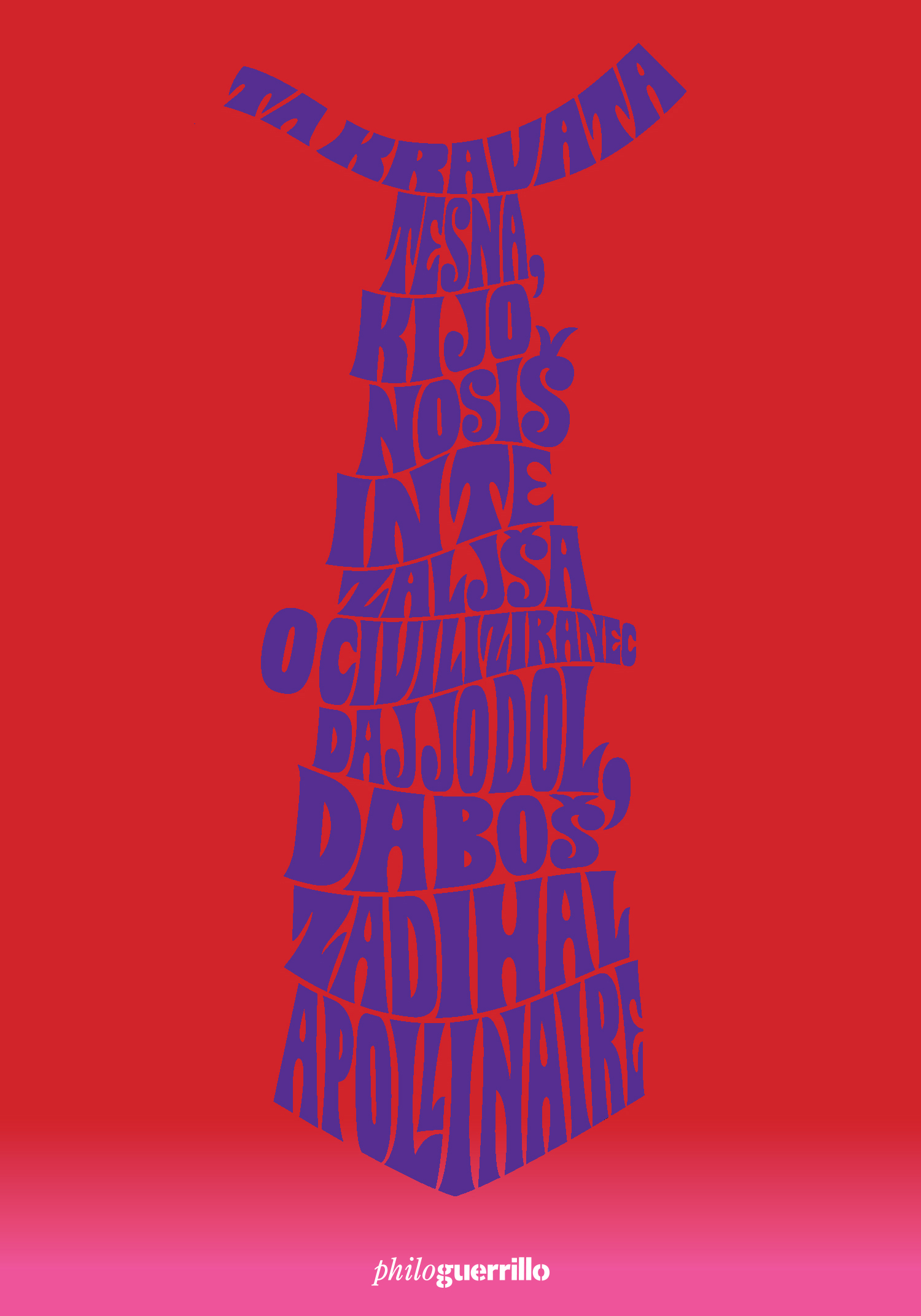
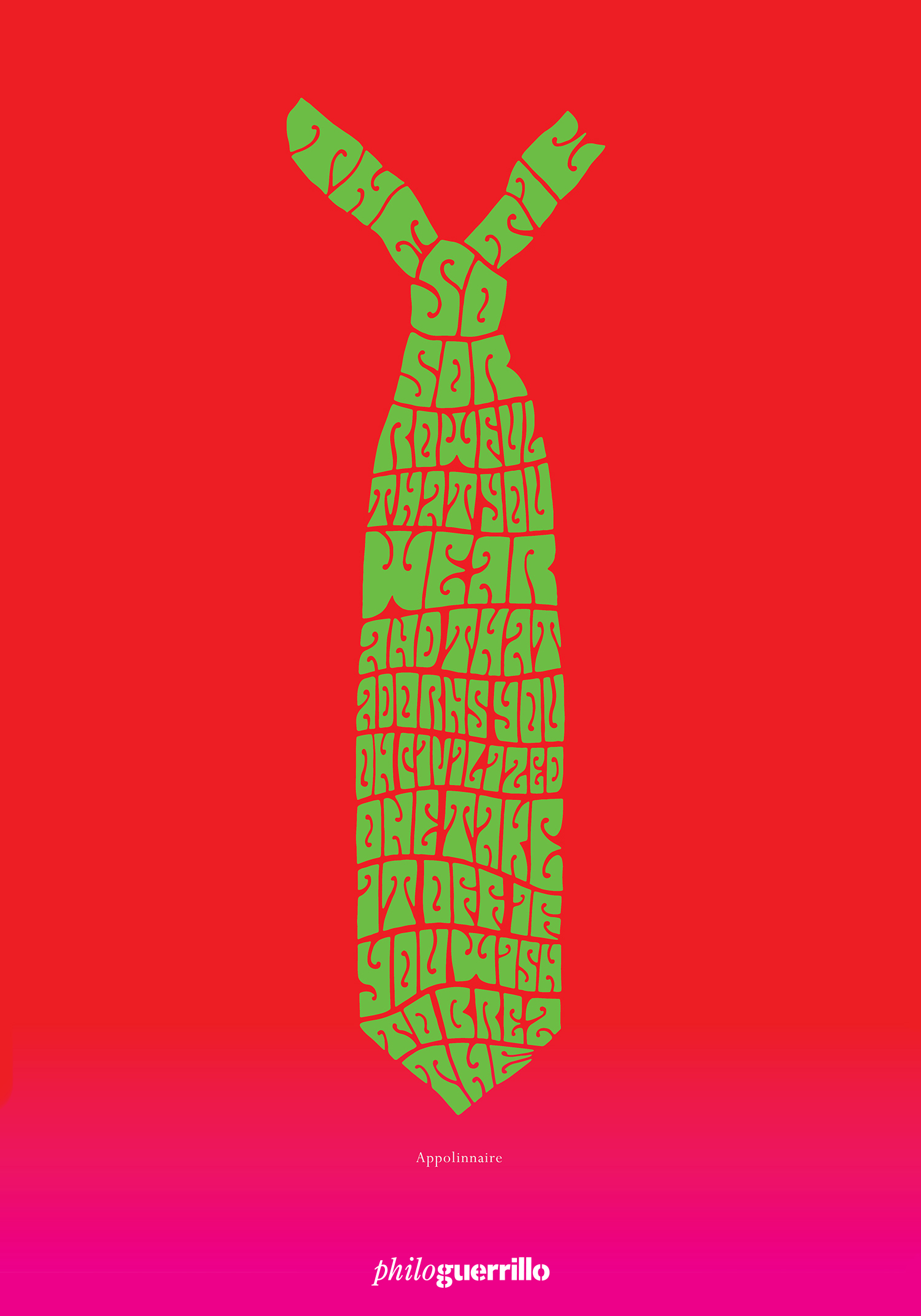
Guillaume Apollinaire (1880–1918), one of the most fascinating and daring figures of the Parisian avant-garde, famously dissolved the boundaries between word and image through his radical elimination of punctuation and visual Calligrammes, paving the way for Dadaism and Surrealism.
The t-shirt design features an original interpretation of his celebrated visual poem shaped like a garment—The Tie (La Cravate). While printing a tie on a t-shirt is a familiar and classic graphic trope, it is incredibly fitting in this context and hits the mark perfectly. By precisely positioning the motif where a real tie would naturally hang, this placement aligns seamlessly with the poet's own philosophy of merging literature with everyday, tangible objects.
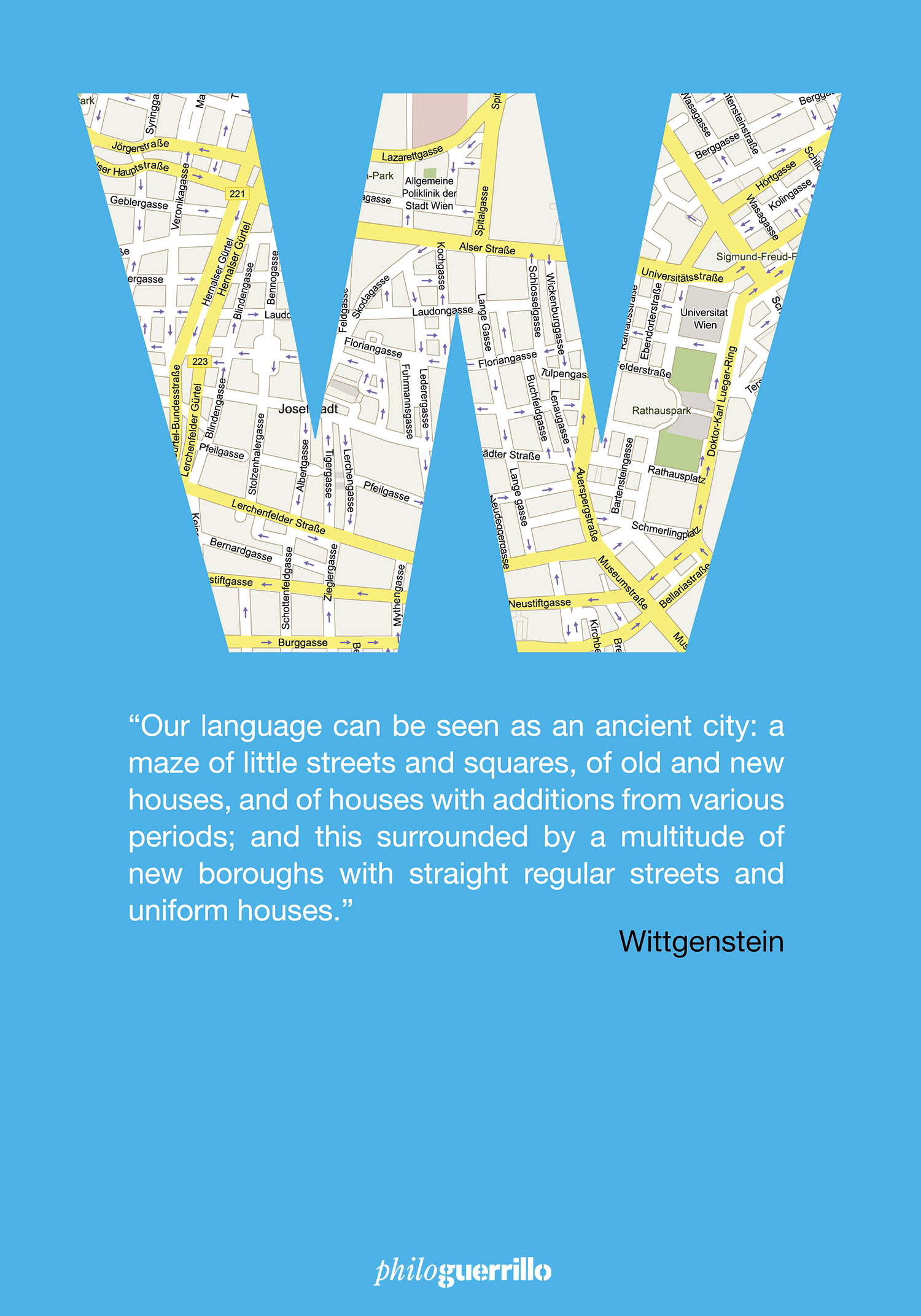
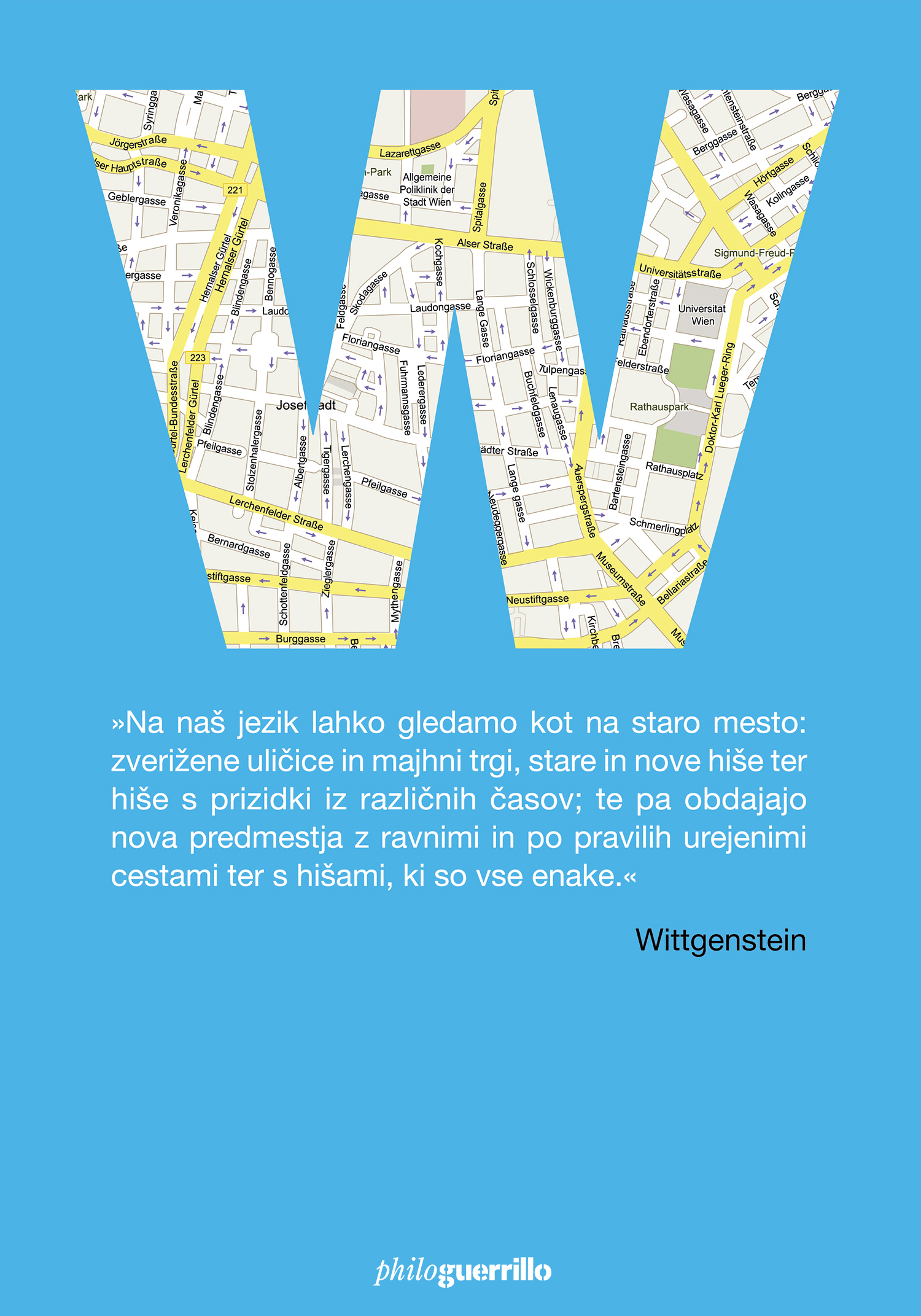
Ludwig Wittgenstein (1889–1951), one of the most influential philosophers of the 20th century, famously compared language to an ancient city—a labyrinth of streets, squares, and houses built across different historical eras.
The t-shirt design visualizes this metaphor through an interpretation of the first letter of the philosopher's last name. The letter "W" is reshaped into a structured city map complete with streets and quarters. This visual solution is fitting, as it intertwines the letter—the fundamental building block of language—with an urban grid, directly embodying Wittgenstein's idea that language is a living organism we understand as we navigate its winding streets.
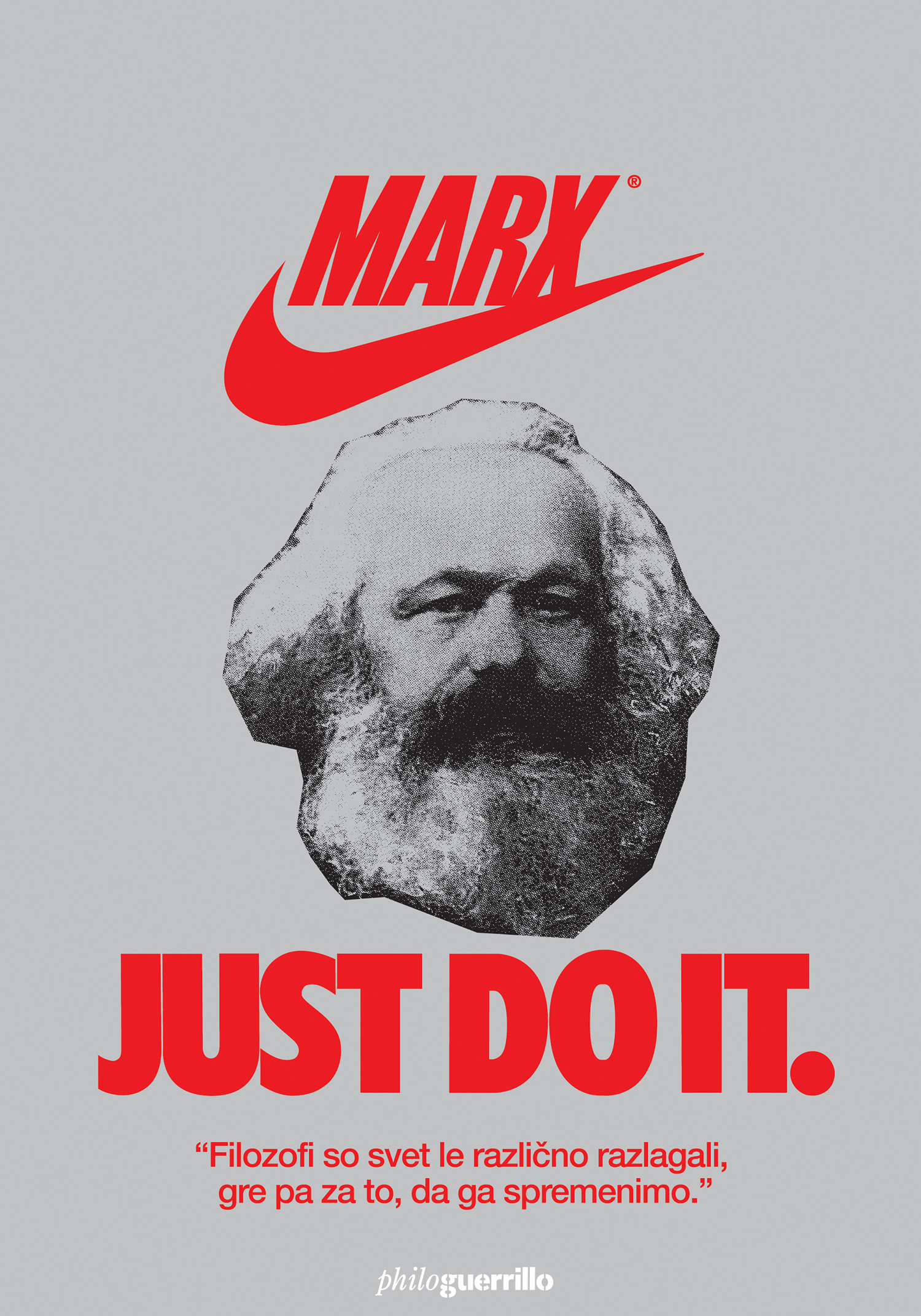
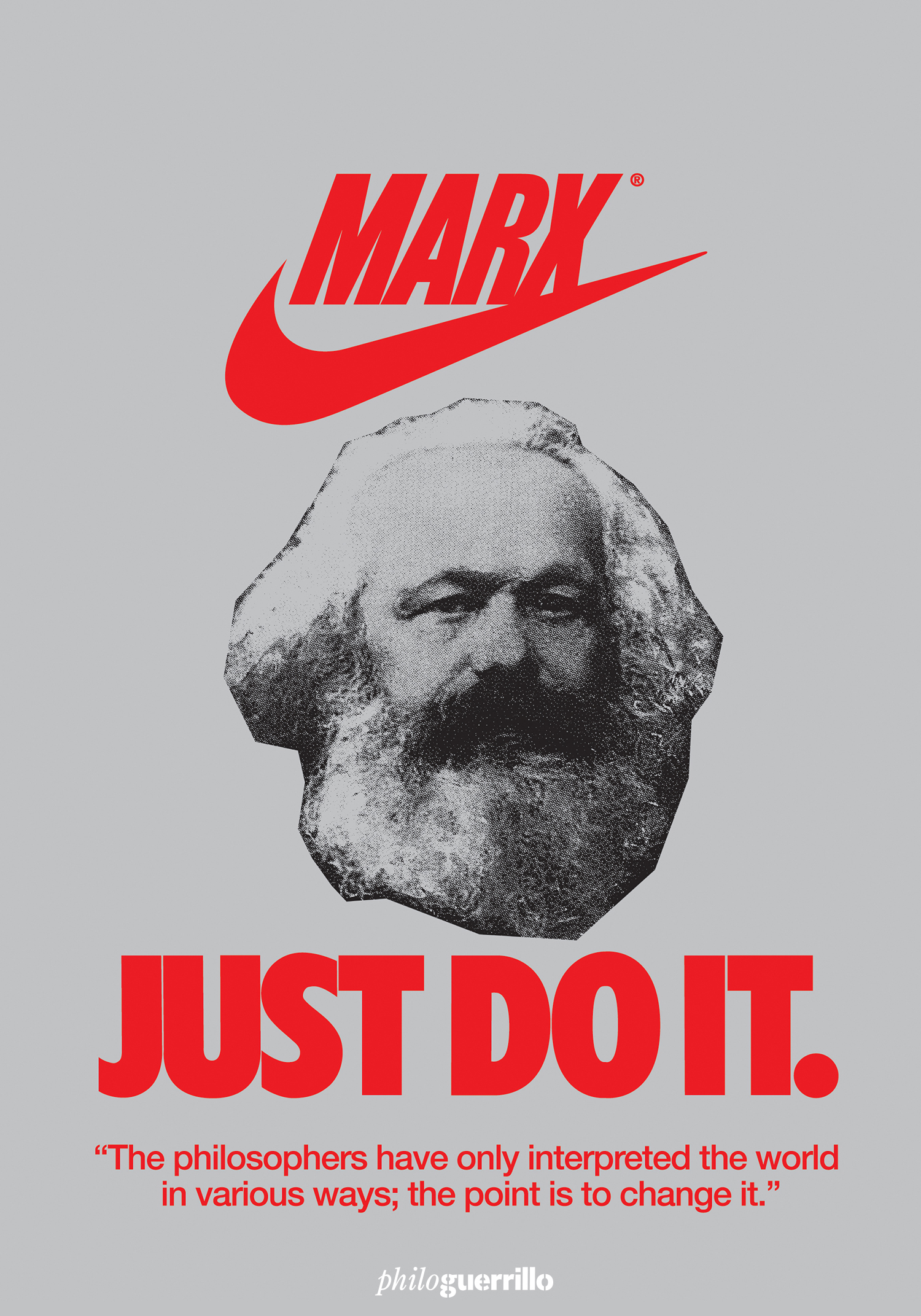
Karl Marx (1818–1883), one of the most influential political philosophers and economists, famously argued that the task of philosophy is not merely to interpret the world, but to change it. By calling for active social engagement and the abolition of exploitation, he laid the groundwork for a radical transformation of society through practice.
The t-shirt design visualizes this philosophical stance by paraphrasing the recognizable sports slogan "Just Do It." This connection is fitting, as it ironically recontextualizes a corporate call to immediate action in light of Marx's imperative for revolutionary agency. Juxtaposing the philosopher's portrait with the slogan directly comments on the intersection of contemporary consumer culture and the historical demand for social change.

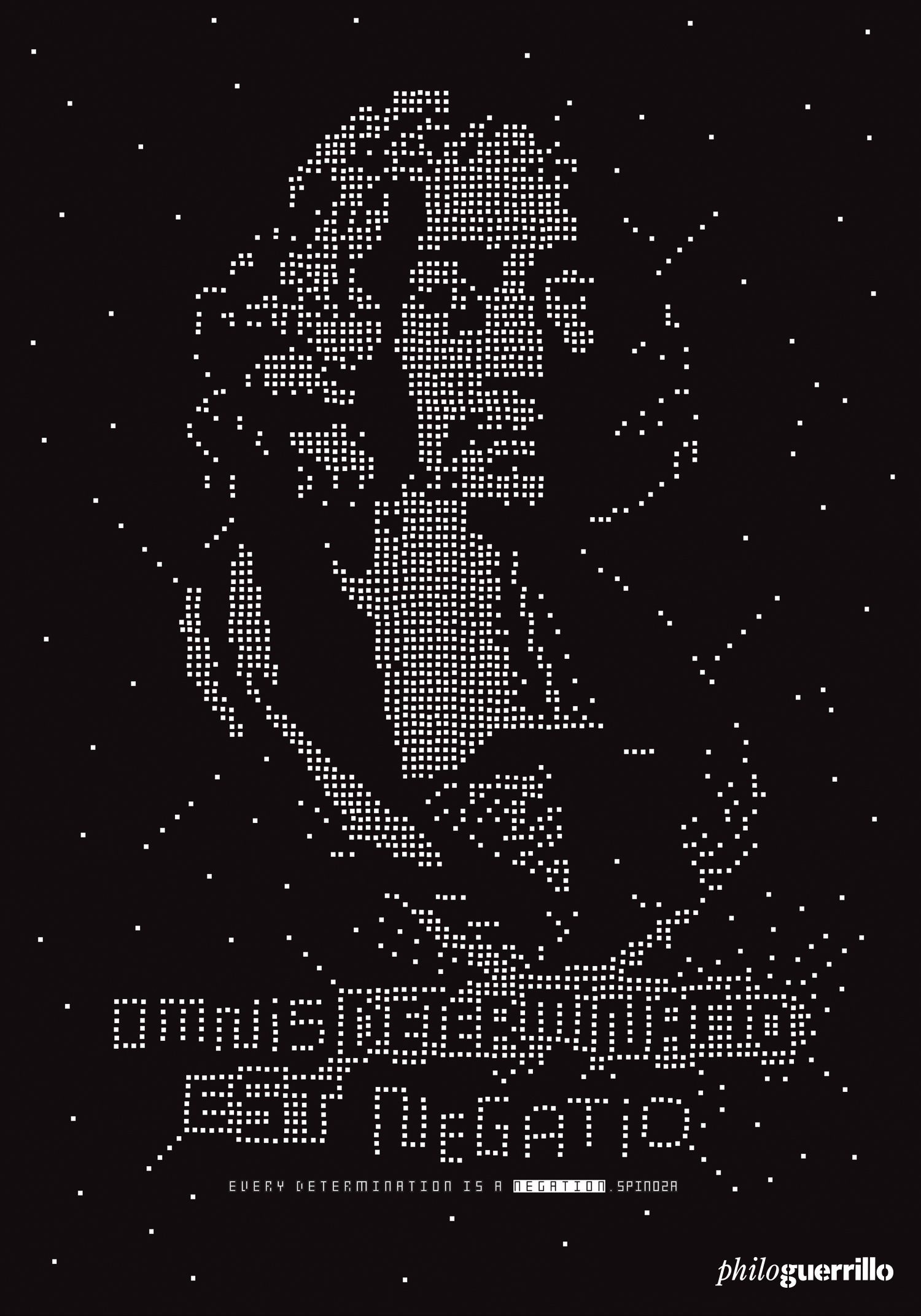
Baruch Spinoza (1632–1677), one of the pivotal rationalist philosophers, posited with his dictum "Omnis determinatio est negatio" that every determination or shaping of a finite thing is inherently a negation. For something to exist as a distinct, recognizable entity with its own boundaries, it must be defined by what it is not—its existence is thus predicated on its separation from everything else.
The t-shirt design visualizes this concept through the play of positive and negative space, where the philosopher's portrait is partially formed by emptiness. This design solution is fitting, as the empty space acts as a negation of form while simultaneously serving as its determination, directly embodying Spinoza's idea of the interdependence and relativity of boundaries in nature.
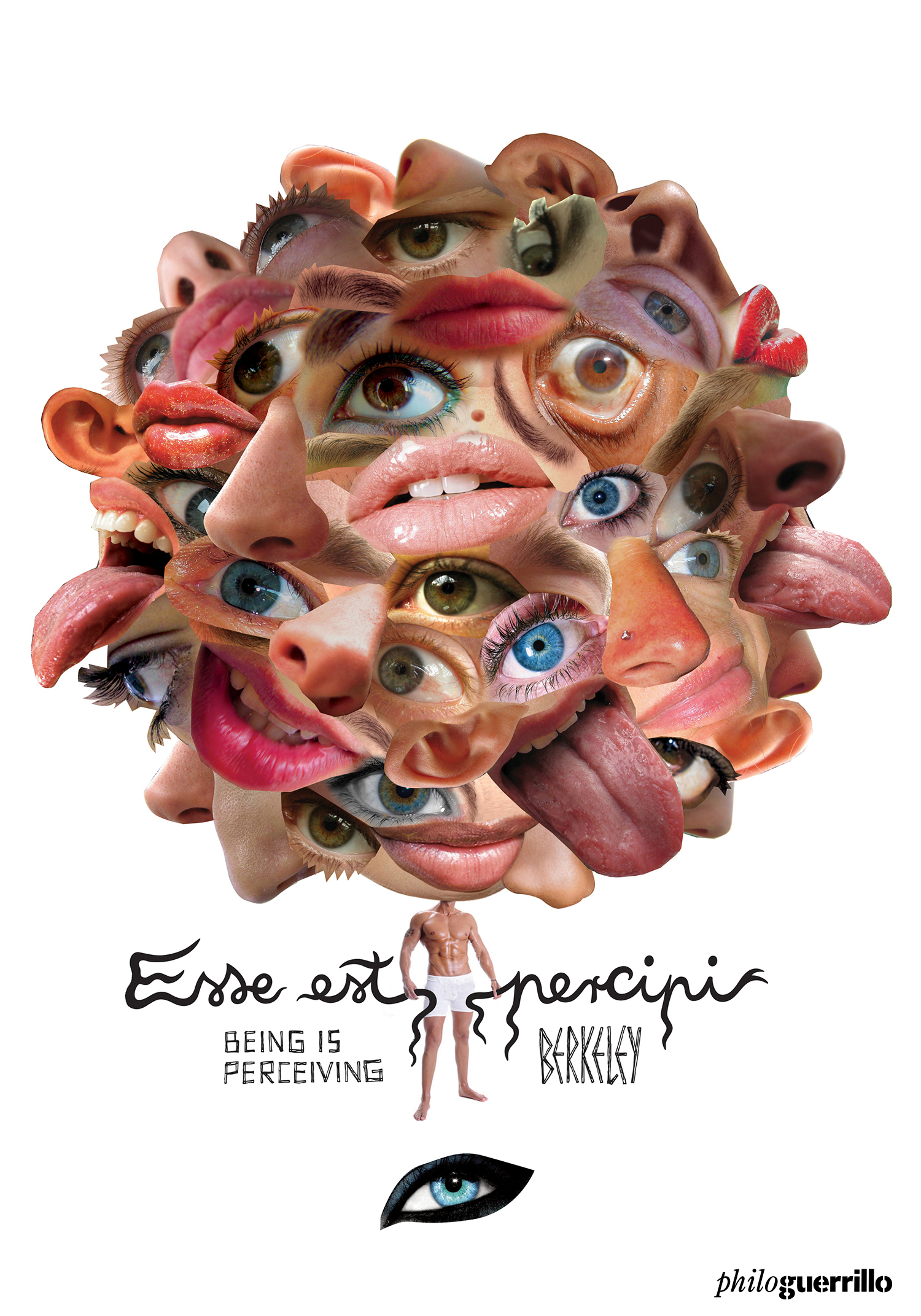
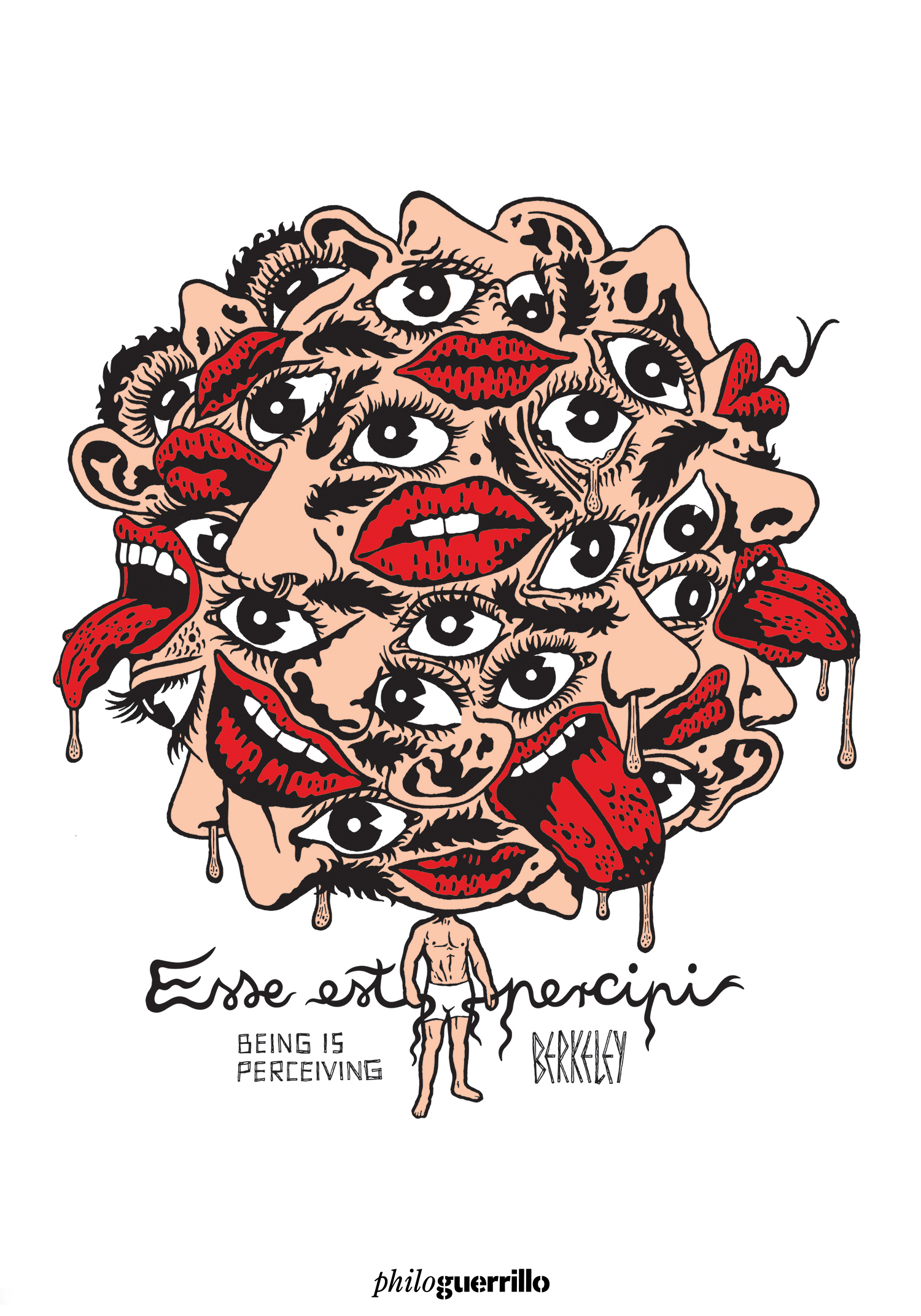
George Berkeley (1685–1753), an influential Irish philosopher and a key figure in classical empiricism, is renowned for his radical dictum "Esse est percipi" (To be is to be perceived). He championed subjective idealism, arguing that material substance does not exist independently of the mind, as the entire world we experience consists solely of our perceptions and sensory impressions.
I have created two graphics of the same motif: one using the technique of photocollage and the other in a drawing style based on that photocollage. The central focus of the piece features exaggerated, prominent sensory organs that dominate the imagery. This design solution directly reflects Berkeley's core thesis, as the visual space is entirely occupied by the very tools of perception that, according to his philosophy, constitute the fabric of our reality.

Sri Ramakrishna (1836–1886), a revered Indian mystic and philosopher, emphasized the essential unity of all religions and taught that the ultimate reality is a single, divine source. Using the metaphor of gold, he famously noted that while ignorance distinguishes between materials, wisdom recognizes that "all is gold," pointing to the divine essence inherent in everything.
In line with Ramakrishna’s vision, I have visualized the entire world as an interconnected whole where everything is fundamentally divine. Through this piece, the perceived separation between things dissolves, reflecting his core philosophy that boundaries are merely an illusion and all existence is woven from the same spiritual fabric.
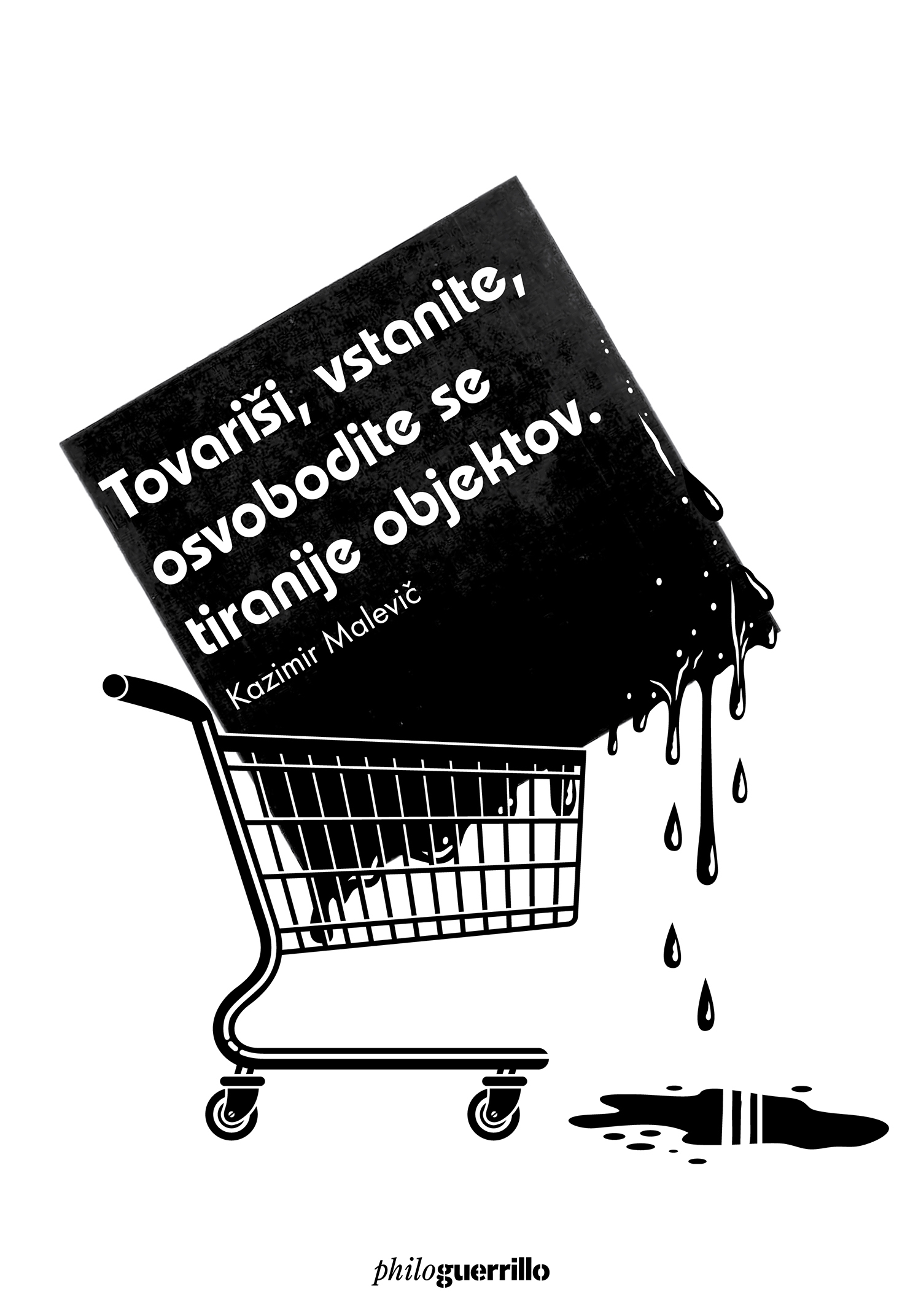
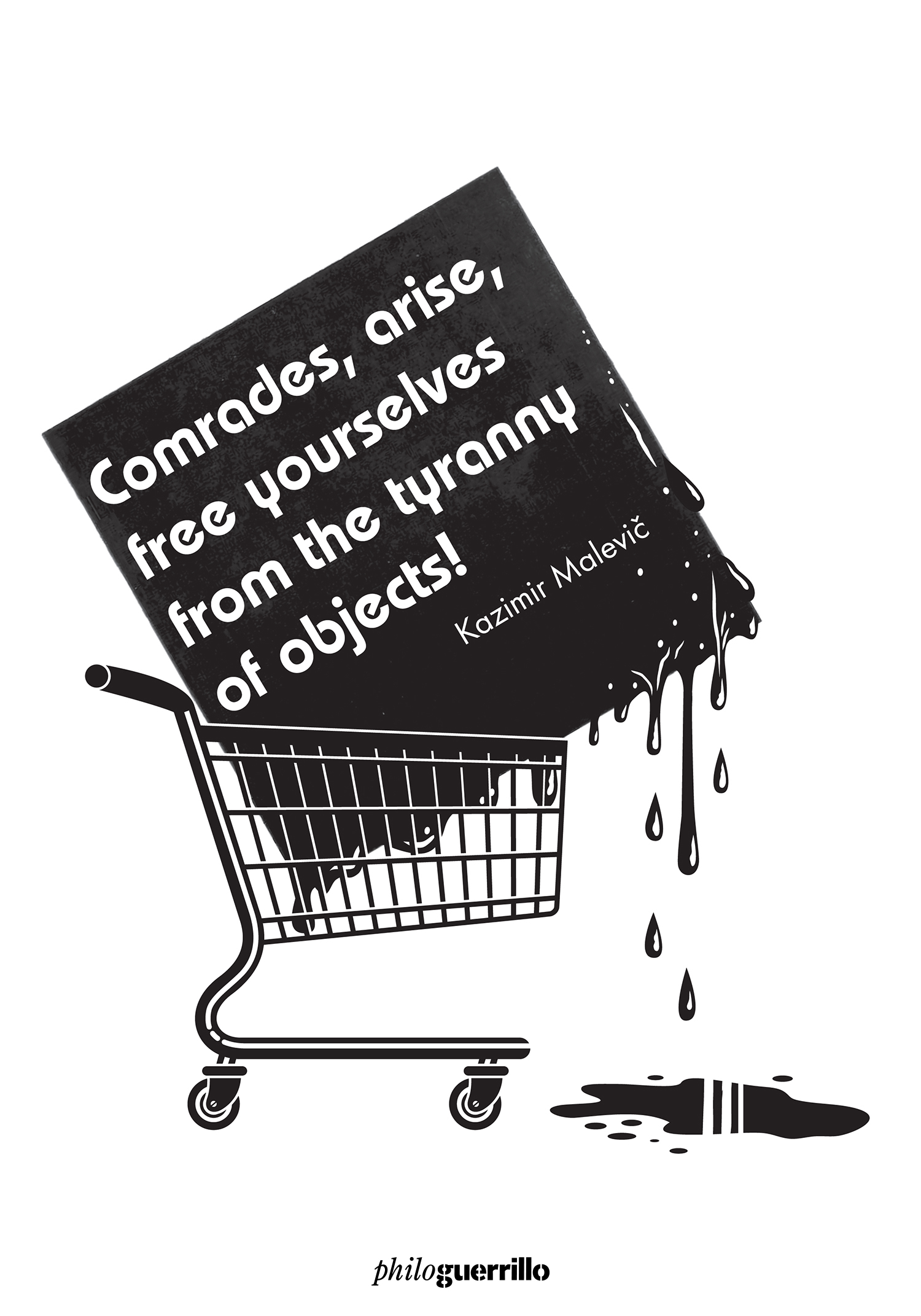
Kazimir Malevich (1879–1935), a pioneer of geometric abstraction and the founder of Suprematism, famously declared his Black Square to be the "zero of form," representing a radical breakthrough into pure, non-objective feeling. He envisioned the square as a liberation from the material world, a spiritual icon that stripped away all consumerist and representational utility.
In this piece, I have visually subverted Malevich’s metaphor with deliberate irony by reimagining his sacred square as a mass-market consumer commodity. By transforming an emblem of ultimate spiritual purity into a commercial product, the work comments on how contemporary consumerism absorbs and commodifies even the most radical attempts at anti-materialism.
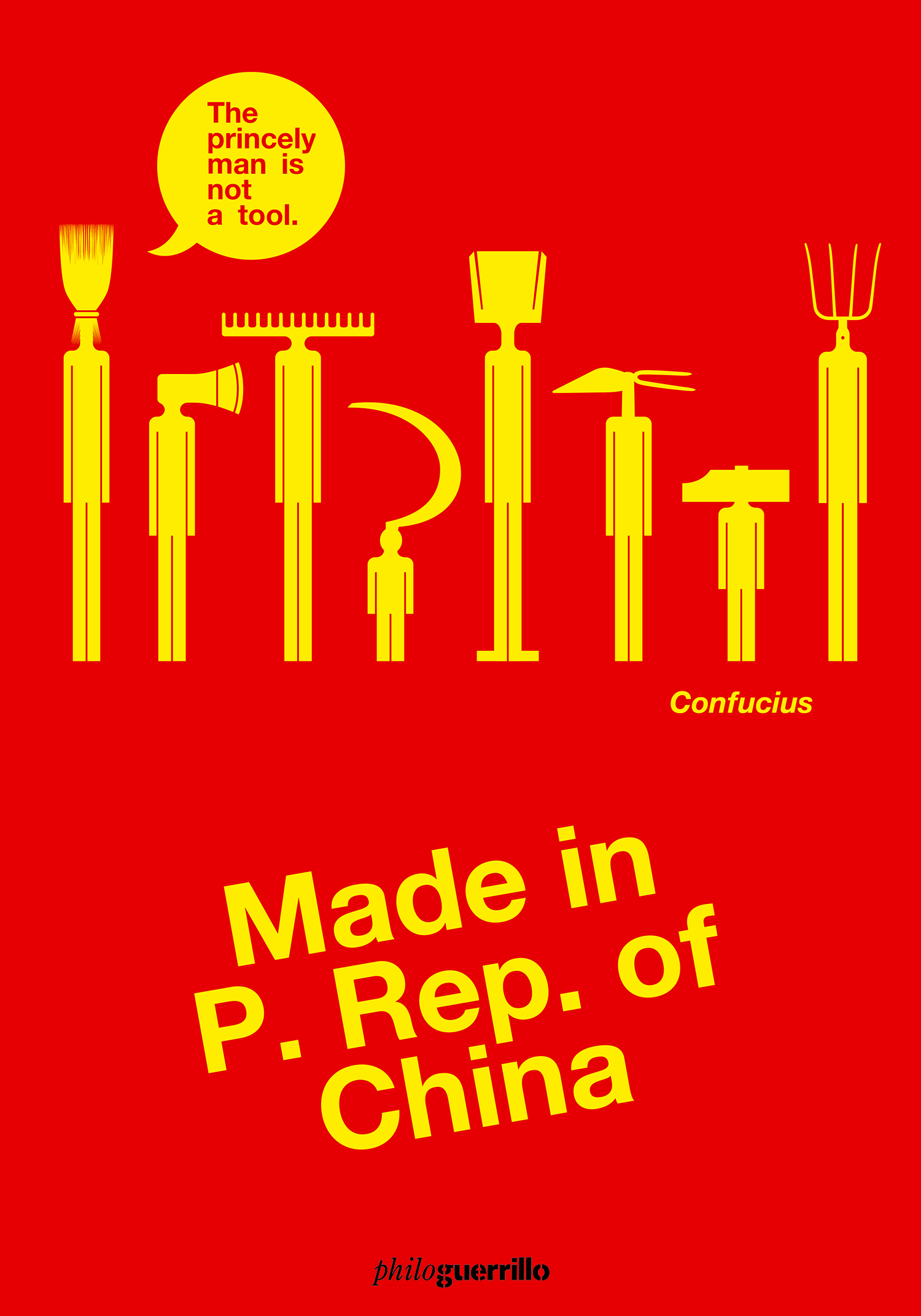
Confucius (551–479 BCE), the foundational philosopher of Chinese civilization, famously asserted that a person of noble character is not a mere tool to be used for a singular, mechanical purpose. He championed human dignity and moral self-cultivation, arguing that individuals possess intrinsic value rather than just utilitarian functionality.
In this work, I ironize Confucius’s philosophical ideal by contrasting it directly with the systemic exploitation of workers during China’s rise as the modern "factory of the world." By depicting human beings precisely as the disposable, industrial machinery his teachings rejected, the piece highlights a tragic historical contradiction, while expressing a quiet hope for a more humane future for global labor.
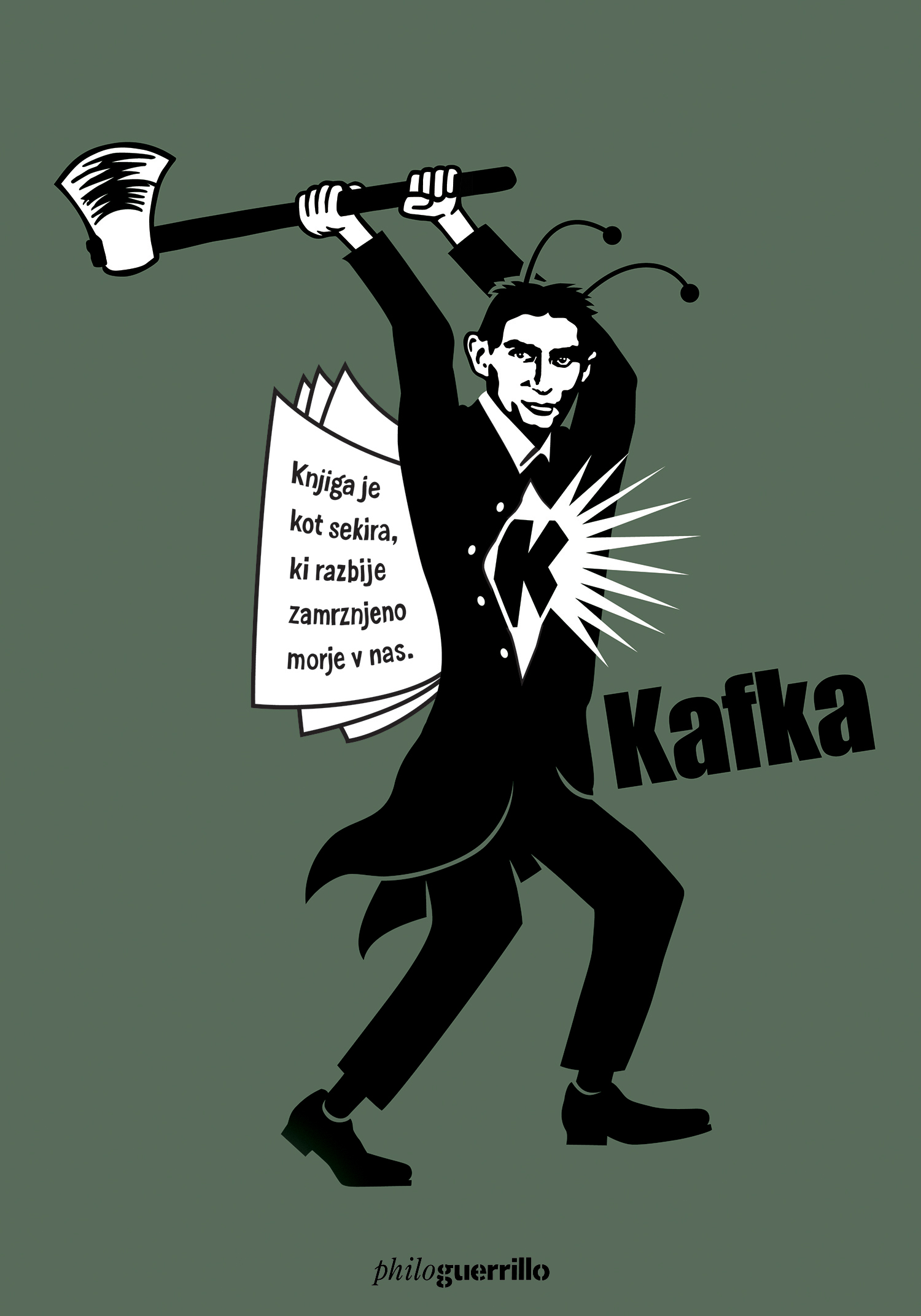
Franz Kafka (1883–1924), a master of existential dread and modernist alienation, famously wrote that a book must be the axe that breaks the frozen sea within us, serving as a painful catalyst for self-awareness. His literature consistently targeted the rigid, numbing structures of bureaucracy and human psychology, demanding that art violently awaken the soul.
In this graphic, I have fused Kafka's literary axe with the tragic imagery from his masterpiece The Metamorphosis, depicting Kafka himself as a superhero beetle who smashes through the frozen sea within us with a powerful strike. By transforming this emblem of ultimate alienation and vulnerability into a figure of heroic power, the visual metaphor captures a profound paradox: under your direction, the agonizing transformation that isolates us becomes a pop-culture spectacle, while remaining the only tool capable of piercing the frozen surface of existence.
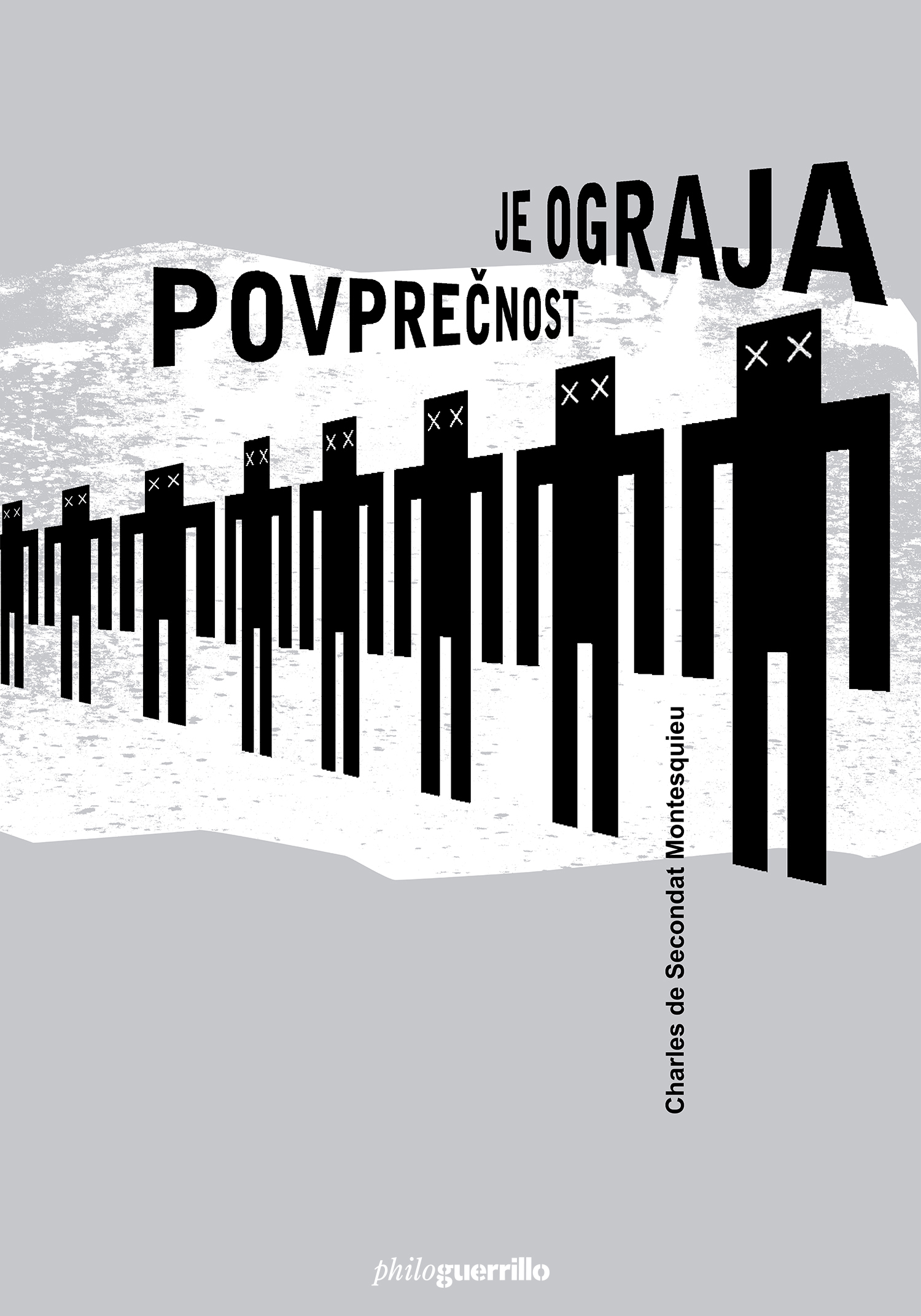
Charles Montesquieu (1689–1755), a brilliant French political philosopher and a key figure of the Enlightenment, famously remarked that mediocrity acts as a fence, creating a barrier that restricts human potential and encloses the mind within safe, uninspired boundaries. He championed liberty, systemic checks and balances, and the cultivation of intellectual virtue over stagnant conformity.
In this piece, I have visually interpreted his metaphor by constructing a literal fence made of soulless, identical bureaucrats in ties. By transforming these embodiment of corporate and administrative mediocrity into a rigid, interlocking barrier, the graphic highlights how collective blandness and lack of empathy create an impenetrable wall that stifles individuality and blocks any path toward true excellence.
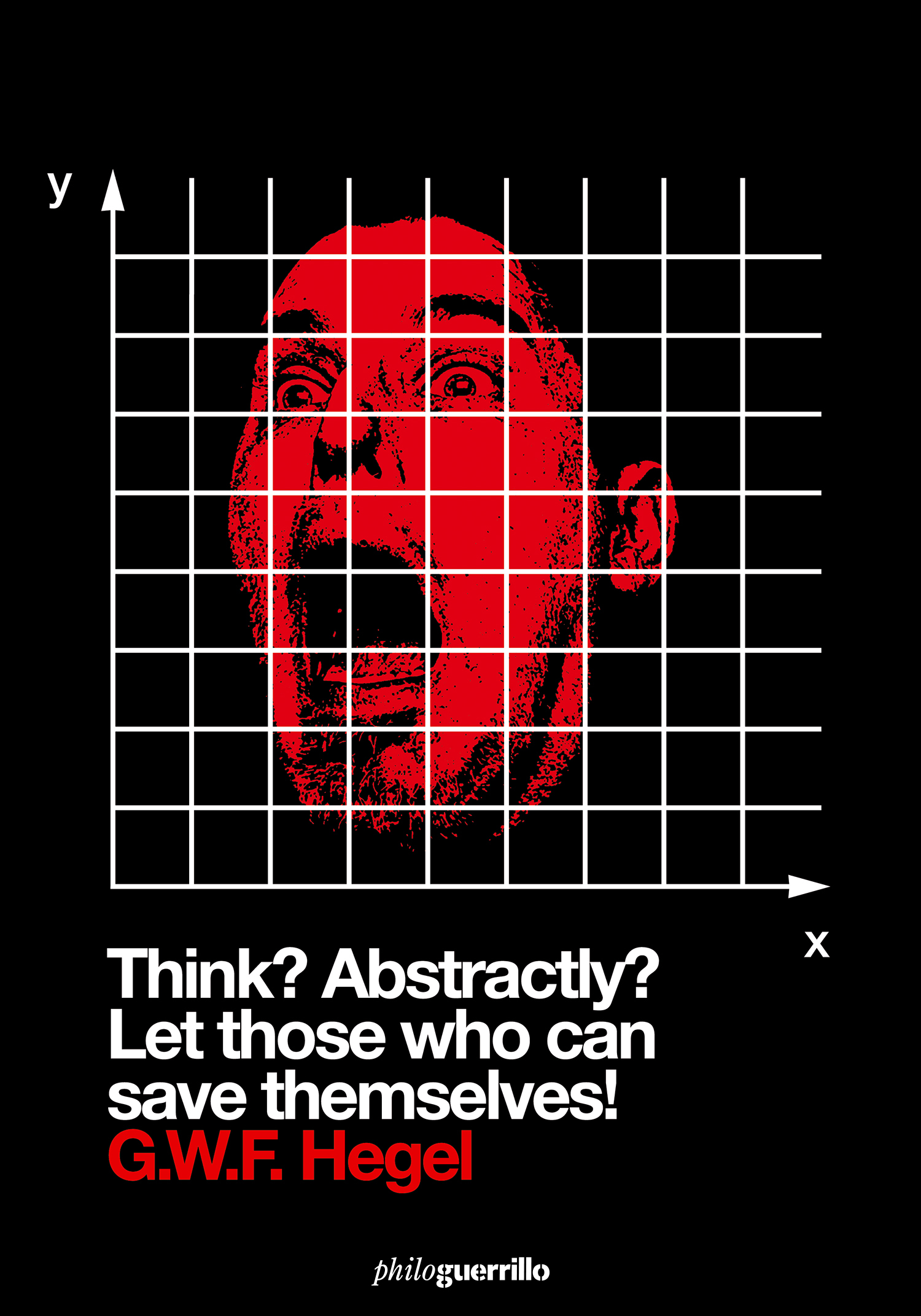
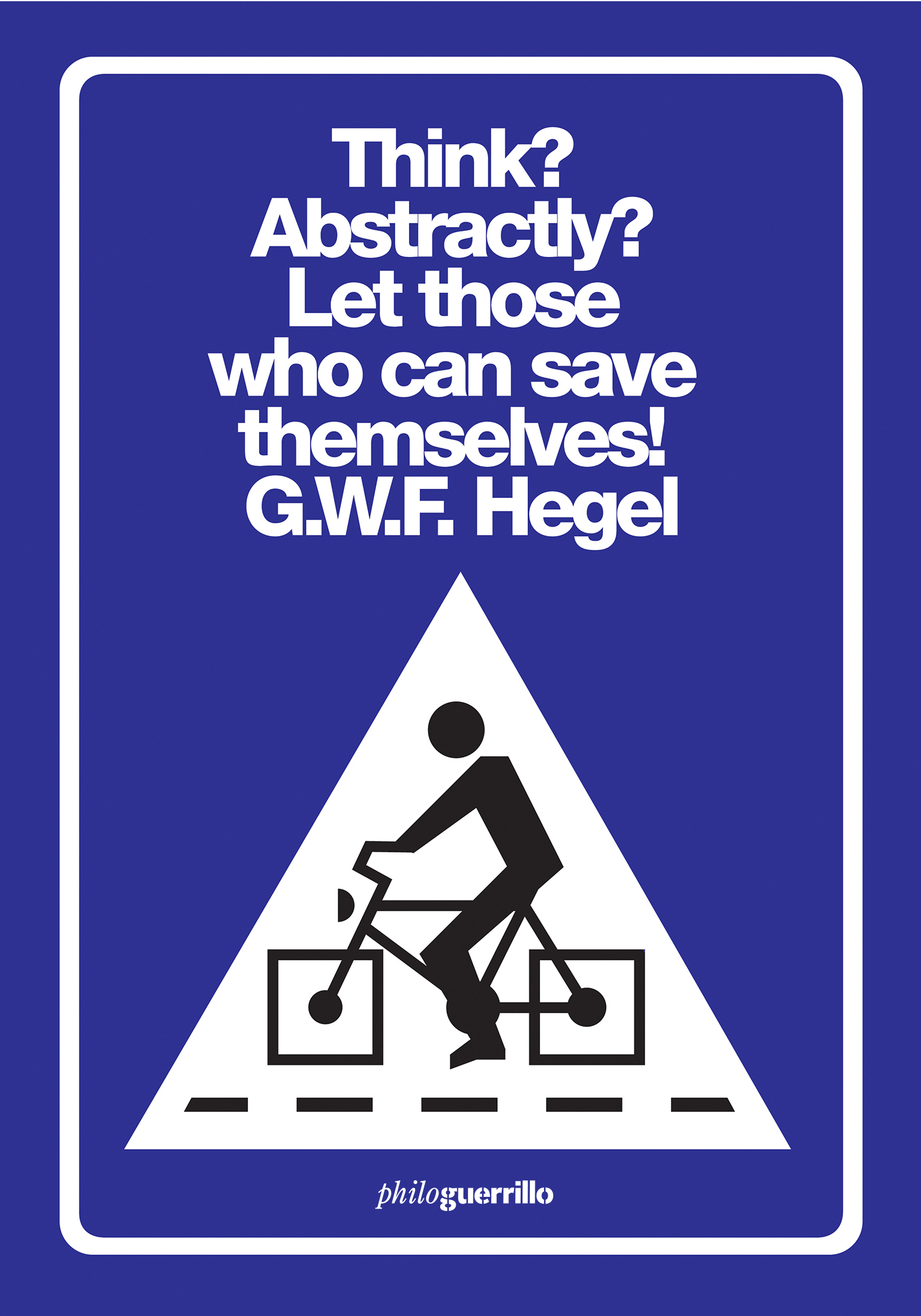
Georg Wilhelm Friedrich Hegel (1770–1831), a monumental figure in German Idealism, explored the complexity of thought in his famous essay Who Thinks Abstractly?, warning against isolating things from their concrete reality. Yet, his own grand philosophical system sought to map all of existence through strict, all-encompassing conceptual frameworks, often subordinating immediate human experience to abstract logic.
In this series, I have created two graphics that humorously critique the pitfalls of such detached, abstract thinking. The first piece is a parody of a traffic sign depicting a bicycle with square wheels—an abstractly flawless theoretical concept that fails completely in practice, proving how pure theory can lead us astray. The second motif reinterprets the Cartesian coordinate system, the ultimate symbol of abstract mapping, as a cage that traps human perception; by overlaying reality with a rigid conceptual grid, it limits our comprehension and completely fails to capture the fluid, unquantifiable phenomena of the human world.
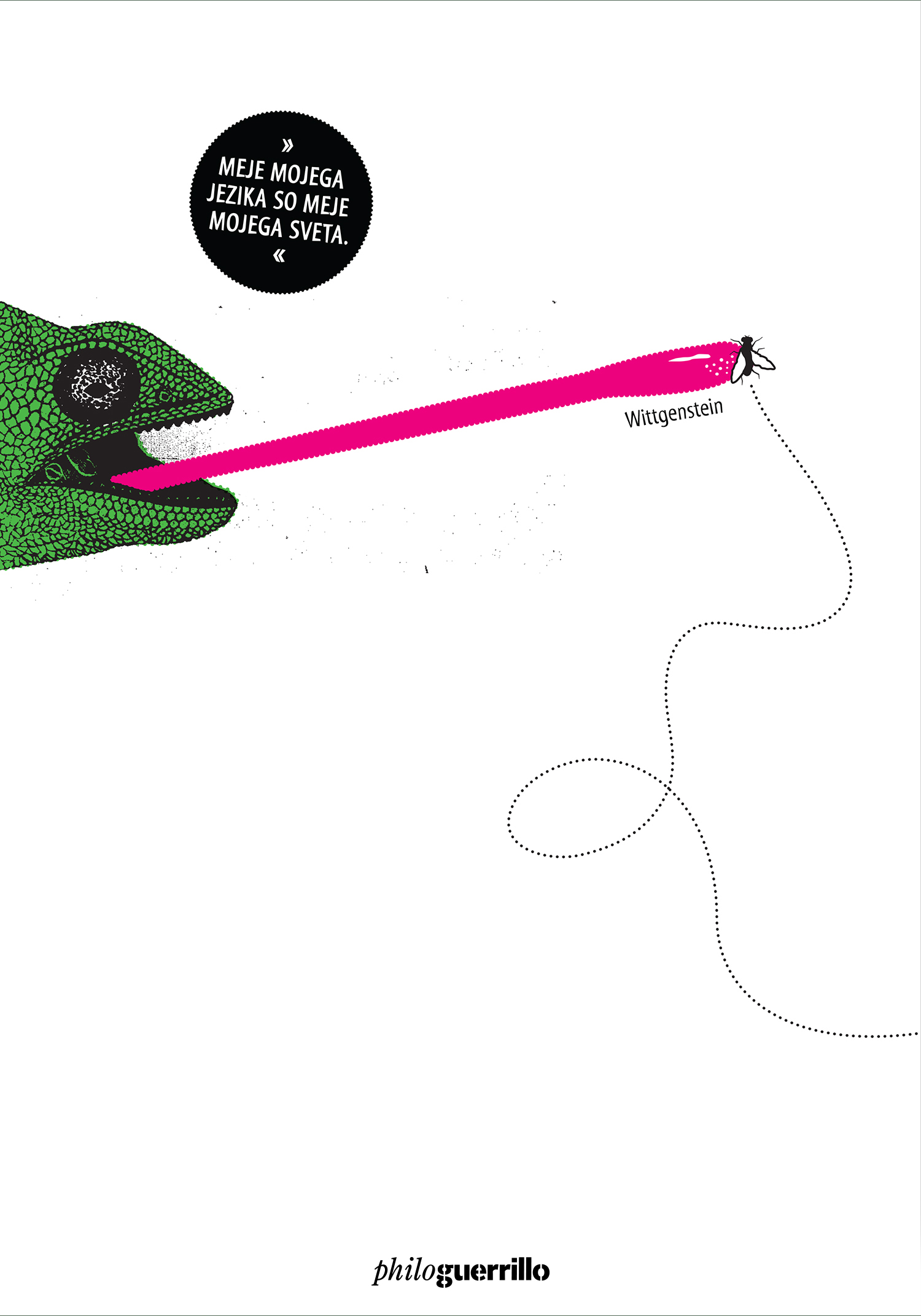
Ludwig Wittgenstein (1889–1951), one of the most influential philosophers of the 20th century, famously declared in his Tractatus Logico-Philosophicus that "the limits of my language mean the limits of my world." He argued that the structure of our language determines the boundaries of what we can think, express, and meaningfully experience, effectively locking us within our linguistic capabilities.
In this graphic, I have created a humorous and literal interpretation of Wittgenstein’s thesis by using a chameleon as the central motif. Known for its extraordinarily long tongue—which in Slovenian translates to the same word as language (jezik)—the chameleon’s very existence literally depends on the reach of its tongue to capture food. By playfully blurring the line between linguistic philosophy and biological survival, the piece illustrates that for this creature, the literal limits of its "language" truly define the boundaries and survival of its world.
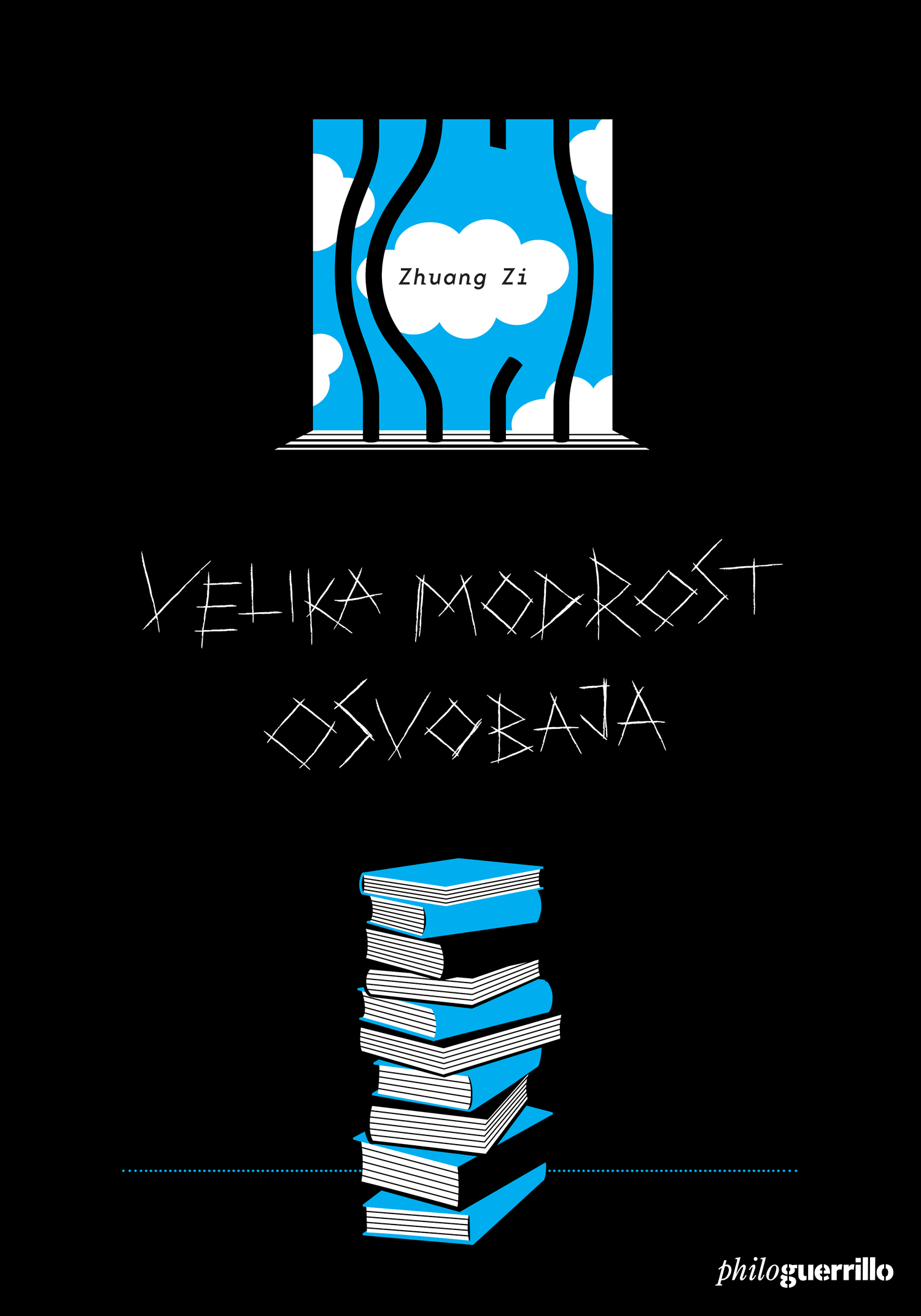
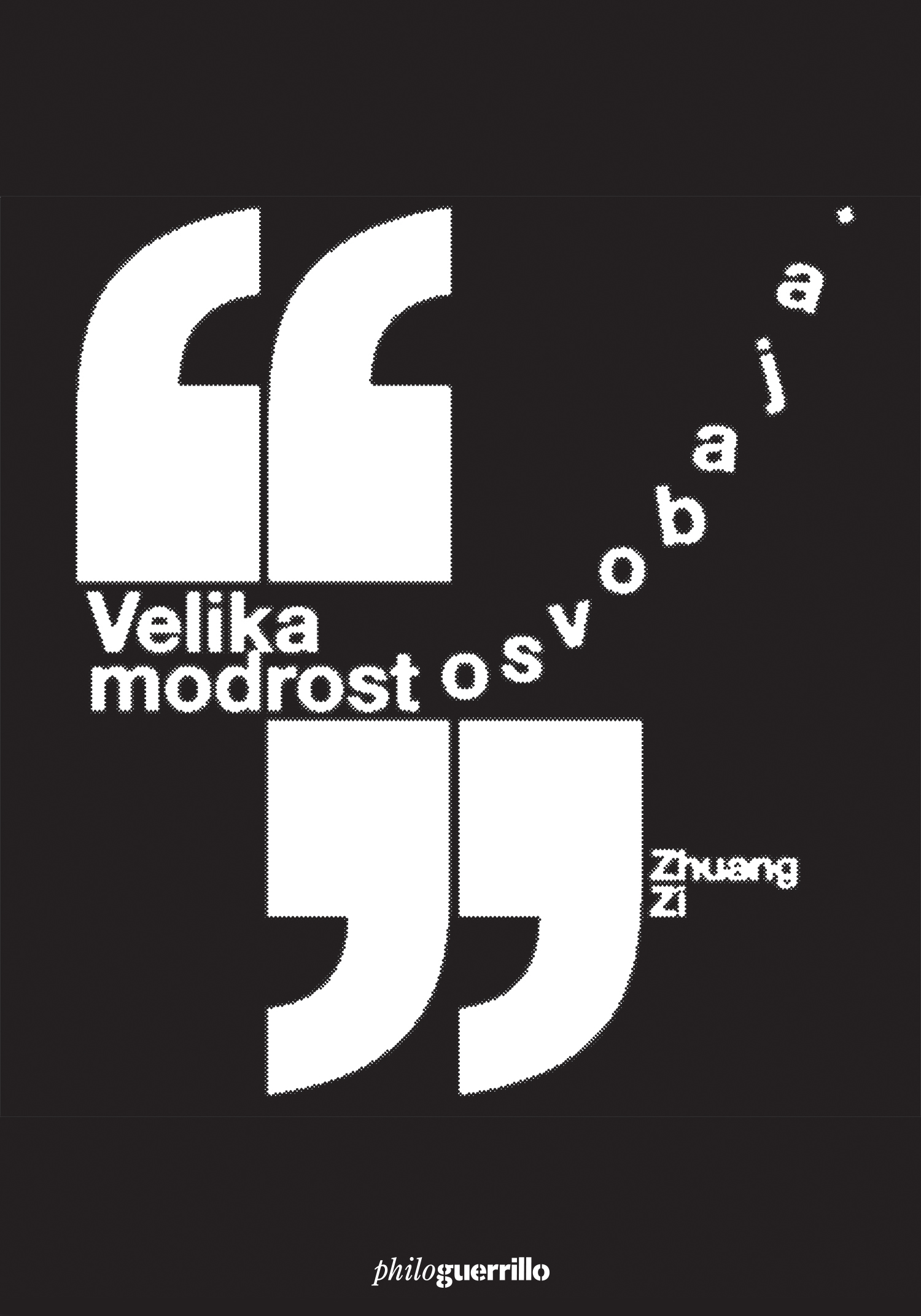
Zhuang Zi (c. 4th century BCE), a seminal figure in classical Daoism, famously championed intellectual spontaneity and freedom, frequently arguing that true wisdom lies in transcending rigid definitions and word games. He cautioned that a mere accumulation of knowledge is not the same as genuine wisdom, as obsessing over dogmatic texts can easily become a mental prison that detaches us from the natural flow of existence.
In this spirit, I have created two graphics that explore the theme of intellectual liberation. The first, a typographic piece, depicts letters rising freely into the sky, shedding the quotation marks that symbolize heavy, over-analytical philosophizing. The second graphic illustrates a literal prison break using books as steps to scale the walls—here, books and the knowledge they contain are transformed from a potential cell into the ultimate tools of liberation, proving that when properly understood, wisdom has the power to set us free.
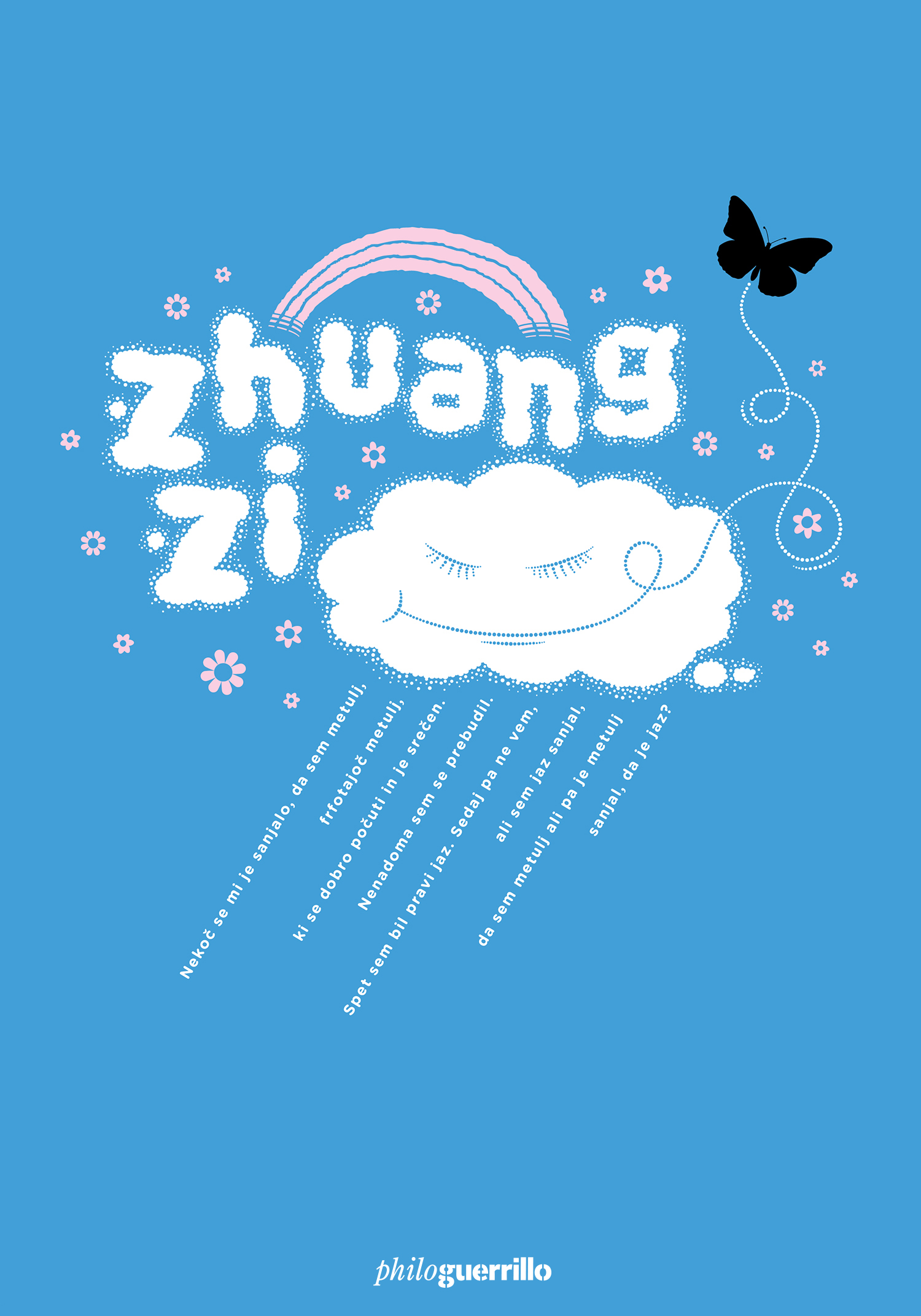
Zhuang Zi (c. 370 BCE) famously contemplated the relativity of reality through his legendary anecdote of the butterfly. After dreaming he was a butterfly fluttering joyfully without any awareness of his human self, he awoke to find himself explicitly Zhuang Zi, leaving him with a profound existential riddle: was he a man who had dreamt he was a butterfly, or was he a butterfly now dreaming he was a man?
In this work, I have visually translated this classic exploration of dream versus waking reality. Zhuang Zi is depicted as a cloud dreaming a butterfly, yet the composition is intentionally ambiguous, suggesting that perhaps the butterfly itself is dreaming the cloud. By dissolving the rigid boundaries of identity into fluid, atmospheric forms, the graphic captures the core of daoist philosophy—that the world we perceive as solid and absolute is profoundly relative, shifting like a dream within a dream.
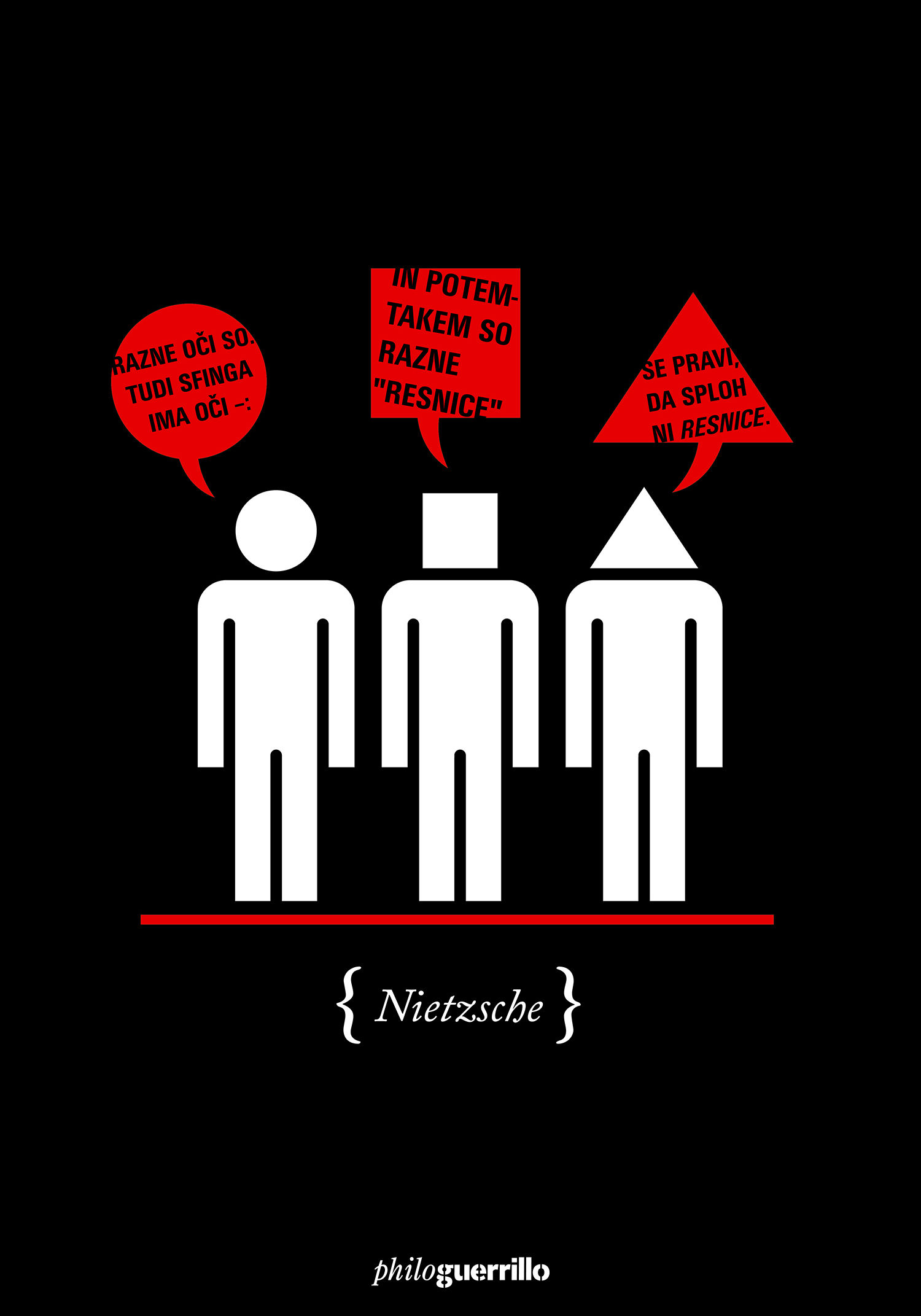
Friedrich Nietzsche (1844–1900), one of the most radical iconoclasts of modern philosophy, famously challenged the notion of absolute truth, asserting that there are no objective facts, only interpretations. He argued that human beings do not discover reality, but rather construct it through their own psychological needs, drives, and structural limitations, leaving each individual trapped within their own subjective perspective.
In this graphic, I have implemented a fresh visual approach by dividing Nietzsche's conceptual critique into a tripartite dialogue embedded within distinct speech bubbles. The composition features characters with different geometric heads: a person with a triangular head thinks and speaks only triangular thoughts, while a person with a square head produces strictly square words. Through this geometric allegory, the piece illustrates that every individual constructs their own reality, suggesting that our "truths" are ultimately shaped by the inherent design of our own minds.
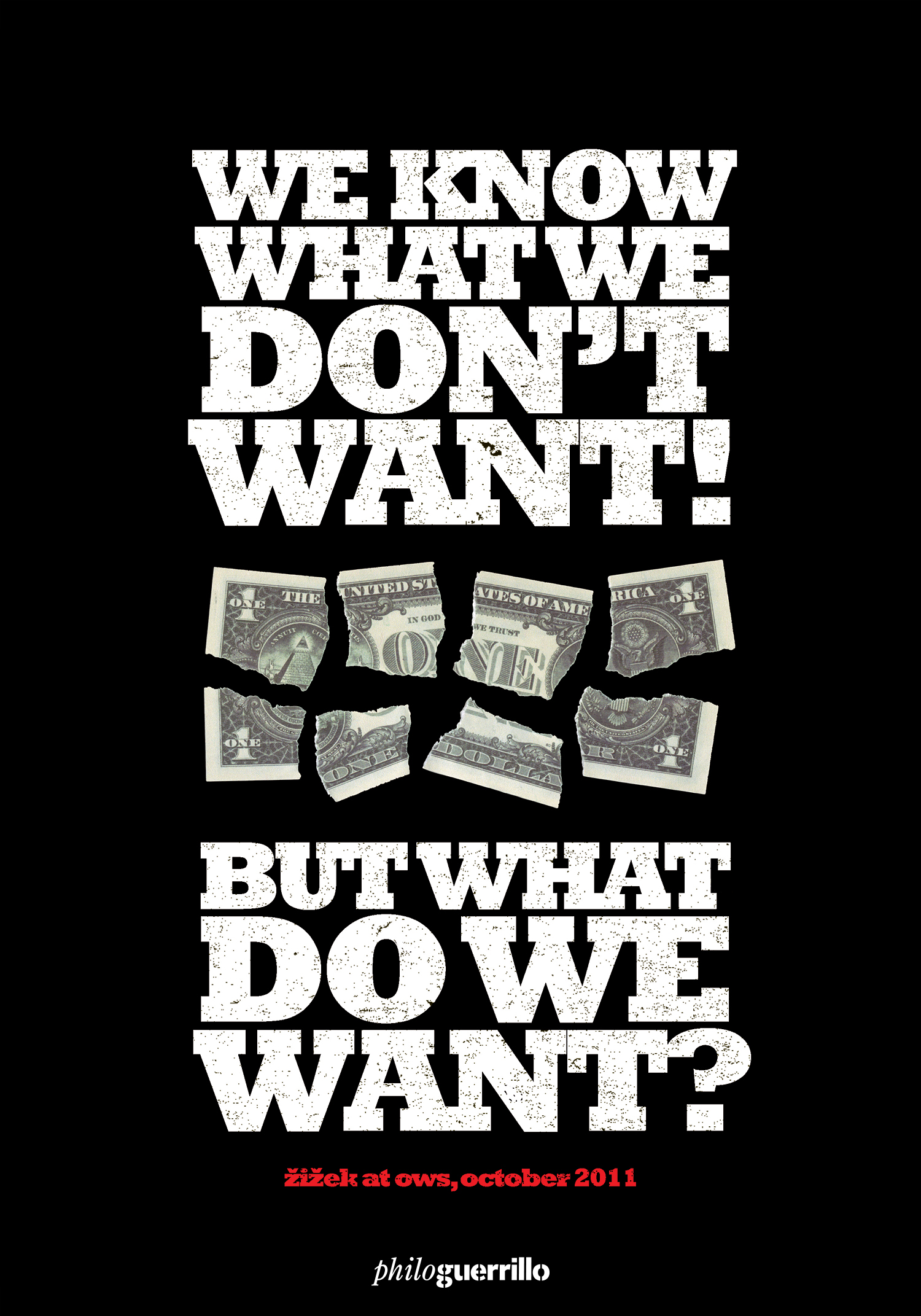
Slavoj Žižek (born 1949), one of the most prominent and provocative contemporary philosophers and cultural critics, delivered a memorable address during the 2011 Occupy Wall Street protests, where he famously remarked: "We know what we don't want. But what do we want?" He targeted the core dilemma of modern radical movements—the ease of uniting in opposition against global capitalism versus the profound difficulty of formulating a clear, alternative vision for the future.
For this piece, I designed a bold, minimalist typographic solution where the sole visual motif is a torn one-dollar bill. By tearing this basic, everyday symbol of currency, the graphic emphasizes how easily the existing system can be disrupted, while highlighting the immediate consequence: it is now utterly useless, and we are left with nothing. The physical rupture perfectly mirrors Žižek’s critique—destroying the emblem of capital is simple, but as we stand empty-handed, we are forced to confront the urgent, unresolved question: What do we do now?